





 coupon
  Gift card


Acupressure Mats vs. Massage Guns: Which is Better for Recovery?
Introduction: The Booming Recovery Tech Market
The global athletic recovery market has exploded in the past five years, generating billions in consumer spending on tools that promise to reduce soreness, accelerate tissue repair, and return athletes to full performance faster. Two categories have emerged as the most widely purchased recovery devices: percussive massage guns and acupressure mats.
Both have devoted followings. Both produce measurable physiological benefits. And yet they operate through fundamentally different biological mechanisms, serve different recovery goals, and are optimally applied at different points in the recovery cycle. Understanding the science behind each is essential for athletes and health enthusiasts who want to invest wisely and recover intelligently.
This guide provides a comprehensive, clinical comparison of massage guns and acupressure mats, examining the mechanisms, strengths, limitations, and ideal use cases of each modality.
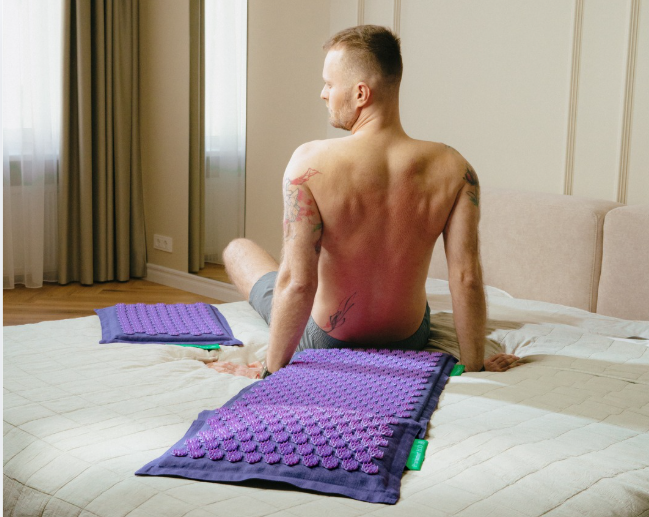
How Percussive Therapy Works
The Mechanism of Percussive Massage
Percussive massage guns deliver rapid, repetitive mechanical force into muscle tissue, typically at frequencies ranging from 1,200 to 3,200 percussions per minute. The high-frequency vibration penetrates beyond the superficial fascia into the belly of the muscle, where it disrupts trigger points — areas of chronic myofascial contraction — and stimulates local blood flow through a process called reactive hyperemia.
The vibration also activates mechanoreceptors throughout the target tissue, temporarily overriding pain signals through a mechanism similar to the Gate Control Theory of pain. This is why applying a massage gun to a sore muscle produces immediate relief, even if the underlying inflammation has not yet resolved.
The Pros of Percussive Therapy
Massage guns excel at delivering targeted, acute relief to a specific muscle or trigger point. They are highly effective for addressing a particular knot in the upper trapezius, releasing a tight hip flexor, or stimulating a chronically sore quadriceps. The ability to adjust pressure and frequency makes them adaptable to different tissue types and tolerances.
They are also highly intuitive to use. Athletes can target the exact location of their discomfort without any required preparation or positioning.
The Cons of Percussive Therapy
Massage guns offer active, localized percussive therapy, requiring physical effort and targeting single muscles sequentially. This is their primary limitation. For an athlete who needs full-body recovery after a marathon, a triathlon, or a heavy powerlifting session, moving a massage gun from muscle group to muscle group is a time-consuming and physically demanding process.
Additionally, massage guns require muscular engagement from the arm and shoulder of the operator throughout the session, which adds a minor but non-trivial metabolic cost to what should ideally be a purely restorative activity. High-quality percussive devices also represent a significant financial investment, with premium models costing several hundred dollars.
How Passive Acupressure Works
The Mechanism of Full-Body Acupressure
Acupressure mats operate through a fundamentally different mechanism. Rather than delivering targeted mechanical force to a single point, the thousands of lotus-shaped spikes distributed across the mat's surface simultaneously stimulate an enormous network of mechanoreceptors, thermoreceptors, and nociceptors across the entire surface of the back, neck, and posterior chain.
This simultaneous, whole-body stimulation triggers a systemic physiological response that a localized percussive device cannot replicate. Passive full-body acupressure covers the entire central nervous system simultaneously, forcing a holistic parasympathetic shift that moves the body from a sympathetic stress state into a profound rest and recovery mode.
The parasympathetic shift has cascading effects: heart rate decreases, cortisol levels drop, blood is redistributed from the muscles supporting high-alert posture to the deep tissues requiring repair, and the brain signals a sustained release of beta-endorphins that provides full-body pain relief while eliminating the physical apathy and fatigue that follow intense exercise.
The Pros of Passive Acupressure
Both modalities increase blood flow, but passive therapy requires zero metabolic output from the user. The athlete simply lies down. No active effort, no device management, no arm fatigue. Within minutes, the full circulatory and neurological response is underway, covering the entire posterior chain from the cervical spine to the sacrum in a single 20-minute session.
The ability to cover the entire back simultaneously is the defining advantage of acupressure mats over percussive devices for whole-body recovery. It is also significantly more economical, with quality acupressure mats providing years of daily use at a fraction of the cost of premium massage guns.
The Cons of Passive Acupressure
The limitation of acupressure mats is their lack of specificity. While the full-body response is their greatest strength for whole-body recovery, athletes seeking to address a single, acute trigger point with high localized force will find percussive therapy more immediately satisfying for that specific application.
Additionally, the initial minutes on an acupressure mat involve a learning curve. The sensation of the lotus spikes is intense, particularly for new users, and many find it takes several sessions before they can fully relax into the mat and allow the parasympathetic shift to occur naturally.
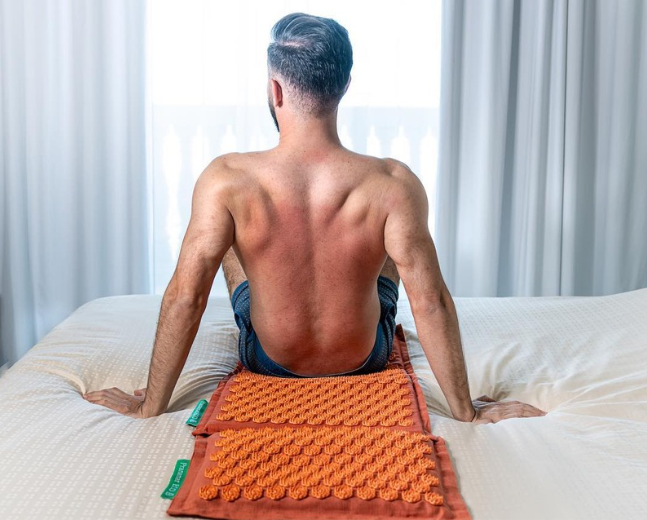
The Pranamat Advantage: Whole-Body Recovery Without the Fatigue of Holding a Device
The core advantage of Pranamat in this comparison is not simply that it covers the whole body, but that it does so while simultaneously producing a clinical-grade parasympathetic nervous system override. No percussive device, regardless of its quality, can replicate this systemic response.
When an athlete lies on the Pranamat for 20 minutes, the lotus-spike stimulation triggers a physiological sequence: initial intense sensory input activates the cutaneous nervous system, followed by a progressive warming and vasodilation response as blood rushes to the skin and underlying tissue. This is followed by the characteristic deep relaxation associated with full parasympathetic engagement, and finally by a sustained beta-endorphin release that provides lasting pain relief and a measurable improvement in mood and energy.
The Pranamat Full Body set extends this coverage to the legs, hips, and feet, making it the most comprehensive passive recovery tool available for athletes who need whole-body treatment after demanding training sessions or competition.
For athletes who already own a massage gun, the Pranamat is not a replacement but a complement. Using the massage gun to address acute trigger points and then transitioning to the Pranamat for full-body parasympathetic recovery creates a more complete recovery session than either device alone provides.
Clinical Evidence Comparison
The evidence base for both modalities continues to grow. Research on percussive therapy demonstrates meaningful improvements in range of motion and perceived soreness when applied immediately post-exercise. Studies on acupressure confirm that 93% of clinical participants experienced significant relief from muscular discomfort after daily 20-minute sessions.
Critically, clinical trials on Pranamat specifically confirm measurable increases in local microcirculation intensity, significant muscular relaxation in 97% of participants, and a full-body reduction in perceived fatigue and apathy. These are physiological outcomes that go beyond the localized effects of percussive therapy.
FAQ: Acupressure Mats vs. Massage Guns
Should I use a massage gun or acupressure mat after training?
Use a massage gun for acute, targeted trigger point work immediately post-exercise. Follow with an acupressure mat session for full-body parasympathetic recovery and systemic microcirculation enhancement. The two modalities work best in combination rather than in competition.
Which modality is better for DOMS?
For Delayed Onset Muscle Soreness that affects large muscle groups or the full posterior chain, passive acupressure is more effective because it covers the entire affected area simultaneously while producing a whole-body anti-inflammatory response. For DOMS concentrated in a single small area, percussive therapy provides faster targeted relief.
Is an acupressure mat safe to use every day?
Yes. Daily use of an acupressure mat is both safe and beneficial for most users. Regular use creates a cumulative reduction in baseline muscular tension and a progressive improvement in sleep quality, stress resilience, and recovery speed.
What is central nervous system coverage in recovery?
Central nervous system coverage refers to the ability of a recovery modality to stimulate the full sensory network of the nervous system simultaneously rather than at a single localized point. Passive full-body acupressure achieves this by stimulating thousands of cutaneous receptors across the entire back and posterior chain at once, triggering a systemic parasympathetic shift that no localized device can replicate.
Are acupressure mats worth the investment?
For athletes, wellness enthusiasts, and anyone managing chronic tension or poor sleep, acupressure mats represent exceptional value. Clinical results including measurably increased local microcirculation, a 95% improvement in sleep quality, and significant muscular relaxation are achieved through a simple daily lying session that costs nothing beyond the initial purchase.
Conclusion
The debate between acupressure mats and massage guns is ultimately a false binary. Both devices address different physiological needs and occupy complementary positions in a complete recovery toolkit. Percussive therapy delivers fast, targeted relief to acute trigger points and requires active effort. Passive acupressure delivers whole-body circulatory, neurological, and endocrinological recovery while the athlete remains completely at rest.
For athletes who train consistently and require recovery solutions that scale with their training demands, investing in both a quality percussive device and the Pranamat creates the most comprehensive recovery stack available — one that addresses the full physiological complexity of post-exercise tissue repair from the surface to the cellular level.